 Add to Chrome
 Add to Firefox
 Add to Edge
Time-Aware Diffusion based on Preference Disentanglement for Generative Recommendation
Jun 01, 2026
Recently, Generative Recommenders (GRs) have emerged as a transformative recommendation paradigm by replacing traditional item IDs with semantic indices (SIDs). Owing to the exceptional generative capabilities of diffusion models, a few pioneering works explore developing GRs with diffusion architectures as the backbone. However, a fatal limitation of existing diffusion-based GRs is that the diffusion process applies uniformly to all items within the historical interactions. In contrast, the user preference is shaped by multifaceted time-evolving factors and thus exhibits a non-stationary distribution in the temporal aspect. To bridge this gap, this study proposes a novel GR framework, named TDPM, by designing the time-aware diffusion on SID tokens. Specifically, TDPM explicitly integrates the impact of time-evolving user preferences into the diffusion process. In detail, the user preference is disentangled into (i) the period preference, which remains consistent over a long time-span, and (ii) the point preference, which is triggered by recent focal events. Extensive experiments on three public real-world datasets demonstrate the significant superiority of TDPM over the state-of-the-art baselines. TDPM achieves average improvements of up to 29.21% and 25.45% in terms of HR@20 and NDCG@20, respectively. The ablation study further underscores the necessity of time-aware token diffusion in diffusion-based GRs.

Detect in Any Scene: An Agentic Framework for Object Detection with Experience-Aware Reasoning
May 29, 2026Object detection in real-world scenarios remains challenging due to diverse image degradations and heterogeneous object distributions, which significantly hinder the generalization of existing detectors. Conventional approaches, including scene-specific representation learning and end-to-end pipeline design, are inherently limited by their reliance on predefined conditions and lack adaptability to dynamic environments. In this paper, we propose DetAS, an agentic detection framework that formulates object detection as a dynamic decision process. Instead of relying on static pipelines, DetAS leverages a Multimodal Large Language Model (MLLM) as a central agent to adaptively compose detection workflows by selecting from a toolbox of restoration modules and specialized detectors. Specifically, DetAS consists of two key components: Self-Adaptive Image Restoration, which dynamically determines whether and how to enhance images for downstream detection, and Multi-Expertise Detection, which integrates multiple domain-specialized detectors and resolves their predictions through instance-level reasoning. To further improve decision quality under fine-grained conditions, we introduce Self-Evolving Experience Harvesting and extend the framework to DetAS-X, which accumulates node-level decision experience from a small set of annotated data and enables experience-aware reasoning during inference. This mechanism allows the system to progressively refine its decision policy and adapt to diverse real-world scenarios. Extensive experiments on six challenging benchmarks demonstrate that DetAS-X significantly outperforms existing MLLM-based detectors, achieving an average improvement of 28.36% in F1 score, with up to 37.01% gain on DarkFace. These results demonstrate the promise of agentic detection and establish a solid foundation for its application in complex and dynamic environments.
Beyond the Aggregation Dilemma: Prior-Retaining Decoupled Learning for Multimodal Graphs
May 23, 2026Multimodal Attributed Graph Learning (MAGL) integrates intrinsic node attributes with structural topology via graph aggregation. However, as pretrained encoders evolve into Large Foundation Models (LFMs), the landscape of MAGL fundamentally shifts: under high-confidence LFM priors, mandatory aggregation introduces topological noise that overwhelms discriminative signals, triggering a counter-intuitive performance inversion where sophisticated MAGL architectures underperform simple topology-agnostic MLPs. Through systematic empirical and theoretical analysis, we identify that this inversion stems from a fundamental aggregation dilemma characterized by two concurrent pathologies: (1) Representational Pathology (SNR Degradation) - mandatory aggregation dilutes robust intrinsic features with topological noise, causing the noise penalty to outweigh its collaborative benefit; and (2) Optimization Pathology (Gradient Starvation) - topological aggregation attenuates gradient flow, while a shared task loss causes dominant modalities to prematurely suppress weaker ones. To resolve this dilemma, we propose SUPRA (Shared-Unique Prior-Retaining Architecture), a decoupled dual-pathway paradigm. SUPRA processes modality-specific features through topology-agnostic MLPs while capturing structural synergy via a lightweight shared GNN, with auxiliary deep supervision counteracting gradient starvation. Extensive evaluations demonstrate that SUPRA achieves state-of-the-art performance while requiring 3.5x lower peak GPU memory and up to 4.4x faster training time than Multimodal Graph Transformers.
Power Reinforcement Post-Training of Text-to-Image Models with Super-Linear Advantage Shaping
May 11, 2026Recently, post-training methods based on reinforcement learning, with a particular focus on Group Relative Policy Optimization (GRPO), have emerged as the robust paradigm for further advancement of text-to-image (T2I) models. However, these methods are often prone to reward hacking, wherein models exploit biases in imperfect reward functions rather than yielding genuine performance gains. In this work, we identify that normalization could lead to miscalibration and directly removing the prompt-level standard deviation term yields an optimal policy ascent direction that is linear in the advantage but still limits the separation of genuine signals from noise. To mitigate the above issues, we propose Super-Linear Advantage Shaping (SLAS) by revisiting the functional update from an information geometry perspective. By extending the Fisher-Rao information metric with advantage-dependent weighting, SLAS introduces a non-linear geometric structure that reshapes the local policy space. This design relaxes constraints along high-advantage directions to amplify informative updates, while tightening those in low-advantage regions to suppress illusory gradients. In addition, batch-level normalization is applied to stabilize training under varying reward scales. Extensive evaluations demonstrate that SLAS consistently surpasses the DanceGRPO baseline across multiple backbones and benchmarks. In particular, it yields faster training dynamics, improved out-of-domain performance on GenEval and UniGenBench++, and enhanced robustness to model scaling, while mitigating reward hacking and preserving semantic and compositional fidelity in generations.
When to Lock Attention: Training-Free KV Control in Video Diffusion
Mar 10, 2026Maintaining background consistency while enhancing foreground quality remains a core challenge in video editing. Injecting full-image information often leads to background artifacts, whereas rigid background locking severely constrains the model's capacity for foreground generation. To address this issue, we propose KV-Lock, a training-free framework tailored for DiT-based video diffusion models. Our core insight is that the hallucination metric (variance of denoising prediction) directly quantifies generation diversity, which is inherently linked to the classifier-free guidance (CFG) scale. Building upon this, KV-Lock leverages diffusion hallucination detection to dynamically schedule two key components: the fusion ratio between cached background key-values (KVs) and newly generated KVs, and the CFG scale. When hallucination risk is detected, KV-Lock strengthens background KV locking and simultaneously amplifies conditional guidance for foreground generation, thereby mitigating artifacts and improving generation fidelity. As a training-free, plug-and-play module, KV-Lock can be easily integrated into any pre-trained DiT-based models. Extensive experiments validate that our method outperforms existing approaches in improved foreground quality with high background fidelity across various video editing tasks.
Rel-MOSS: Towards Imbalanced Relational Deep Learning on Relational Databases
Mar 09, 2026In recent advances, to enable a fully data-driven learning paradigm on relational databases (RDB), relational deep learning (RDL) is proposed to structure the RDB as a heterogeneous entity graph and adopt the graph neural network (GNN) as the predictive model. However, existing RDL methods neglect the imbalance problem of relational data in RDBs and risk under-representing the minority entities, leading to an unusable model in practice. In this work, we investigate, for the first time, class imbalance problem in RDB entity classification and design the relation-centric minority synthetic over-sampling GNN (Rel-MOSS), in order to fill a critical void in the current literature. Specifically, to mitigate the issue of minority-related information being submerged by majority counterparts, we design the relation-wise gating controller to modulate neighborhood messages from each individual relation type. Based on the relational-gated representations, we further propose the relation-guided minority synthesizer for over-sampling, which integrates the entity relational signatures to maintain relational consistency. Extensive experiments on 12 entity classification datasets provide compelling evidence for the superiority of Rel-MOSS, yielding an average improvement of up to 2.46% and 4.00% in terms of Balanced Accuracy and G-Mean, compared with SOTA RDL methods and classic methods for handling class imbalance.
SimGR: Escaping the Pitfalls of Generative Decoding in LLM-based Recommendation
Feb 08, 2026A core objective in recommender systems is to accurately model the distribution of user preferences over items to enable personalized recommendations. Recently, driven by the strong generative capabilities of large language models (LLMs), LLM-based generative recommendation has become increasingly popular. However, we observe that existing methods inevitably introduce systematic bias when estimating item-level preference distributions. Specifically, autoregressive generation suffers from incomplete coverage due to beam search pruning, while parallel generation distorts probabilities by assuming token independence. We attribute this issue to a fundamental modeling mismatch: these methods approximate item-level distributions via token-level generation, which inherently induces approximation errors. Through both theoretical analysis and empirical validation, we demonstrate that token-level generation cannot faithfully substitute item-level generation, leading to biased item distributions. To address this, we propose \textbf{Sim}ply \textbf{G}enerative \textbf{R}ecommendation (\textbf{SimGR}), a framework that directly models item-level preference distributions in a shared latent space and ranks items by similarity, thereby aligning the modeling objective with recommendation and mitigating distributional distortion. Extensive experiments across multiple datasets and LLM backbones show that SimGR consistently outperforms existing generative recommenders. Our code is available at https://anonymous.4open.science/r/SimGR-C408/
Beyond Perfect APIs: A Comprehensive Evaluation of LLM Agents Under Real-World API Complexity
Jan 01, 2026We introduce WildAGTEval, a benchmark designed to evaluate large language model (LLM) agents' function-calling capabilities under realistic API complexity. Unlike prior work that assumes an idealized API system and disregards real-world factors such as noisy API outputs, WildAGTEval accounts for two dimensions of real-world complexity: 1. API specification, which includes detailed documentation and usage constraints, and 2. API execution, which captures runtime challenges. Consequently, WildAGTEval offers (i) an API system encompassing 60 distinct complexity scenarios that can be composed into approximately 32K test configurations, and (ii) user-agent interactions for evaluating LLM agents on these scenarios. Using WildAGTEval, we systematically assess several advanced LLMs and observe that most scenarios are challenging, with irrelevant information complexity posing the greatest difficulty and reducing the performance of strong LLMs by 27.3%. Furthermore, our qualitative analysis reveals that LLMs occasionally distort user intent merely to claim task completion, critically affecting user satisfaction.
Careful Queries, Credible Results: Teaching RAG Models Advanced Web Search Tools with Reinforcement Learning
Aug 11, 2025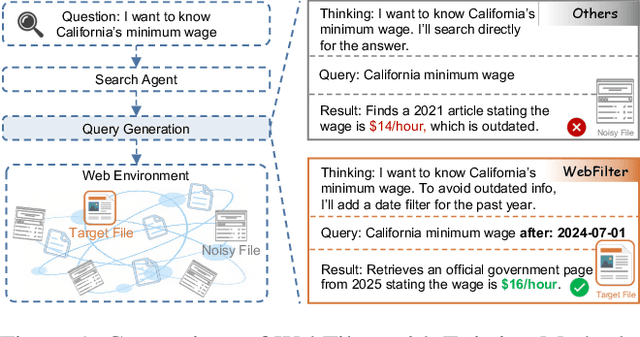
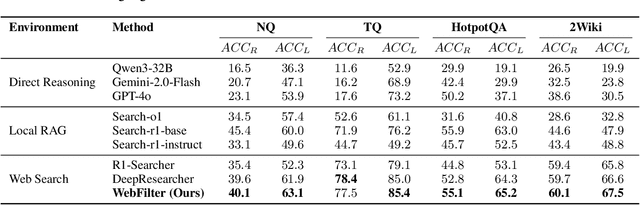
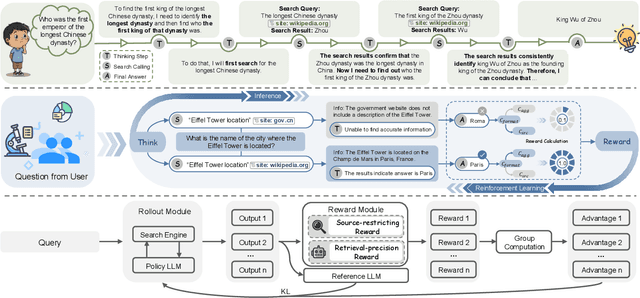
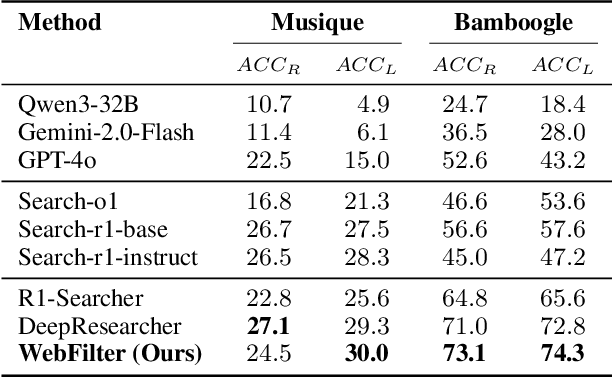
Retrieval-Augmented Generation (RAG) enhances large language models (LLMs) by integrating up-to-date external knowledge, yet real-world web environments present unique challenges. These limitations manifest as two key challenges: pervasive misinformation in the web environment, which introduces unreliable or misleading content that can degrade retrieval accuracy, and the underutilization of web tools, which, if effectively employed, could enhance query precision and help mitigate this noise, ultimately improving the retrieval results in RAG systems. To address these issues, we propose WebFilter, a novel RAG framework that generates source-restricted queries and filters out unreliable content. This approach combines a retrieval filtering mechanism with a behavior- and outcome-driven reward strategy, optimizing both query formulation and retrieval outcomes. Extensive experiments demonstrate that WebFilter improves answer quality and retrieval precision, outperforming existing RAG methods on both in-domain and out-of-domain benchmarks.
SAMST: A Transformer framework based on SAM pseudo label filtering for remote sensing semi-supervised semantic segmentation
Jul 16, 2025Public remote sensing datasets often face limitations in universality due to resolution variability and inconsistent land cover category definitions. To harness the vast pool of unlabeled remote sensing data, we propose SAMST, a semi-supervised semantic segmentation method. SAMST leverages the strengths of the Segment Anything Model (SAM) in zero-shot generalization and boundary detection. SAMST iteratively refines pseudo-labels through two main components: supervised model self-training using both labeled and pseudo-labeled data, and a SAM-based Pseudo-label Refiner. The Pseudo-label Refiner comprises three modules: a Threshold Filter Module for preprocessing, a Prompt Generation Module for extracting connected regions and generating prompts for SAM, and a Label Refinement Module for final label stitching. By integrating the generalization power of large models with the training efficiency of small models, SAMST improves pseudo-label accuracy, thereby enhancing overall model performance. Experiments on the Potsdam dataset validate the effectiveness and feasibility of SAMST, demonstrating its potential to address the challenges posed by limited labeled data in remote sensing semantic segmentation.